Author: Jim Roberts

  • Dining & Tipping in the Post‑COVID Era: What’s Changed — and What Stays the Same

    Dining & Tipping in the Post‑COVID Era: What’s Changed — and What Stays the Same

    When the pandemic hit, dining out went from social outing to logistical feat. As restaurants closed or shifted to takeout and delivery, tipping norms changed dramatically. Now, with dining rooms reopened and life settling into a new rhythm, we’re seeing long-lasting shifts in how people eat — and tip.

    A recent survey from CouponCabin offers a revealing look at these post-pandemic habits. You can view their original infographic here.

    Key Stats from the Survey

    • 1,007 U.S. adults were surveyed in August 2025 about their current dining and tipping habits.
    • 33% of Americans say they tip more now than they did before the pandemic.
    • 62% tip about the same, and only 5% say they tip less.
    • The most common tipping amount was 20%, with 34% of respondents selecting it.
    • 8% of people tip more than 20%, while 19% tip less than 10%.
    • 35% of people now dine out more than they did pre-pandemic.

    (Sources: CouponCabin, Newsweek)

    What This Means for Tipping Culture

    1. Tipping is rising — even with inflation

    Despite rising prices and economic uncertainty, many Americans have continued to tip generously. That pandemic-era empathy for service workers seems to have stuck — but is it sustainable?

    2. The 20% standard holds, but extremes are growing

    While 20% remains the tipping “anchor,” more people are moving above or below that range. This signals growing frustration on one end — and growing pressure on the other.

    3. Dining out feels more premium

    Dining out is no longer the default. Many people treat it as a special experience — and tip accordingly. But when expectations rise in casual or takeout settings, it raises questions about fairness.

    4. Tips are replacing wages

    As tipping becomes universal — even for counter service or takeout — it’s clear that businesses are still relying on customers to cover what should be base wages. The line between tip and wage has never been blurrier.

    What Can You Do as a Diner?

    Be intentional. Tip when it feels appropriate, not just because the screen prompts you to. Don’t be afraid to customize. You don’t have to accept a default of 25% for a muffin and coffee. Support businesses that pay fairly. The best way to end tipping culture is to reward places that bake fair wages into their pricing.

    Related Reading on EndTippingCulture.org

    Attachment.pngTipping on Rideshare and Delivery Apps Attachment.pngTipping at Dog Groomers: Private vs. PetSmart Attachment.pngExtreme Tip Prompts: What to Do When 100% Is an Option

    Final Takeaway

    The pandemic didn’t just change how we live — it changed how we tip. What started as a show of solidarity has evolved into a system that too often feels obligatory and unbalanced. As tipping culture continues to grow in scope and expectation, it’s time to have an honest conversation about where the responsibility lies — and whether this is the system we want to keep.

  • The Rise of Extreme Tip Prompts: What’s the Highest You’ve Seen?

    The Rise of Extreme Tip Prompts: What’s the Highest You’ve Seen?

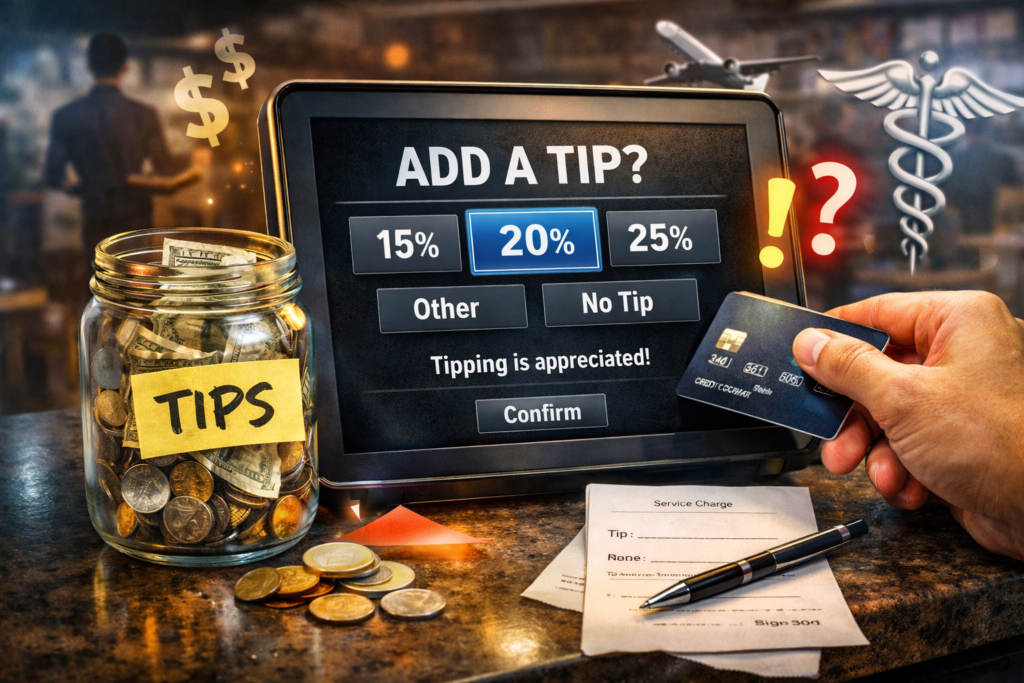
    You’re checking out at a casual cafe. The total is $16.66. The screen flashes:

    Add a Tip – 40% | 60% | 100%

    No 15%, no 20% — just sky-high suggestions that make you pause, sweat, and wonder…

    “Wait, is 100% a real option now?”

    Welcome to the newest phase of tipflation — where businesses, kiosks, and digital checkouts push gratuity prompts that border on the absurd.

    📈 How Did We Get Here?

    Tipping has long been a social norm — originally reserved for full-service restaurants where servers earned below minimum wage. But as more businesses adopt digital POS systems (like Square and Toast), tipping has crept into all corners of commerce:

    Cafes Retail counters Self-service yogurt shops Even automated kiosks

    Now, businesses can set default tip ranges — and many are pushing higher and higher percentages under the guise of “supporting staff.”

    🚨 100%? Really?

    It’s one thing to ask for 15–20%. That’s still (barely) within cultural expectations. But tip options of 40%, 60%, or 100% shift tipping from gratitude to pressure-driven upsell.

    And that creates serious problems:

    Customers feel manipulated, not generous. Workers are blamed if tips don’t meet expectations — even when prices are already high. Businesses benefit by outsourcing wage increases to the customer instead of adjusting pay structures.

    This tactic is subtle — it doesn’t require you to tip that much — but it places social guilt squarely in the middle of a financial transaction.

    🤔 So, What Should You Do?

    Don’t feel bad for skipping or customizing You’re allowed to tap “No Tip” or “Custom Tip.” It doesn’t make you a bad person. You’re reacting to a system designed to make you feel cornered. Consider the service context Did someone prepare food, handle your order, or go above and beyond? A small tip may feel appropriate. Was this self-service, takeout, or cashier-only? No tip is fine. Many agree that these scenarios don’t warrant gratuity. Support fair wages, not forced generosity If you’re uncomfortable with extreme prompts, support businesses that pay their staff fairly and include costs transparently in their prices — rather than relying on guilt-tipping.

    💬 Join the Conversation

    We want to hear from you:

    What’s the highest tip percentage you’ve ever been prompted to give?

    Have you seen 100%… or more?

    🟢 Send us a photo, a story, or just vent.

    📸 Tag: @EndTippingCulture on FB

    We’ll feature the most outrageous examples in our upcoming article:

    “Screenshotted & Shamed: Tip Prompts Gone Too Far”

    📌 Final Thought

    When tip screens push triple-digit suggestions, the problem isn’t generosity — it’s expectation creep. Let’s return tipping to what it was meant to be: a thank you, not a tax.

  • No-Tip Business Models: How Restaurants, Salons & Hotels Are Making It Work

    No-Tip Business Models: How Restaurants, Salons & Hotels Are Making It Work

    For decades, tipping has been baked into American culture — a system that often shifts the responsibility for fair pay from employers to customers. But across the U.S., a growing number of restaurants, salons, and even hotels are breaking the mold by eliminating tips altogether and replacing them with higher wages and transparent pricing.

    The result? A movement toward fairness that challenges long-held assumptions about how service work should be rewarded.

    Why Some Businesses Are Ditching Tips

    The “no-tipping” model is gaining traction for a few reasons. First, service industry employers are increasingly aware that the traditional tipping system often creates wage instability, inequality, and even bias.

    Many no-tip establishments now pay hourly rates well above the tipped minimum wage — sometimes double or triple what employees previously earned before tips. Instead of relying on unpredictable gratuities, workers receive steady paychecks, benefits, and more predictable schedules.

    “It’s about giving people dignity and security,” says one restaurant owner in Seattle who replaced tipping with a service-included model. “I want my team to know exactly what they’re earning — without wondering if a slow night means they can’t pay rent.”

    How They Make It Work Financially

    Eliminating tips doesn’t mean cutting corners. Most no-tip businesses adjust their menu or service pricing to include what would normally be the tip — typically a 15–20% increase.

    For customers, that means slightly higher prices but no math or awkward decisions at the end of the meal or service. For businesses, it creates a sustainable structure that rewards staff fairly and consistently.

    Some companies use a “revenue share” model, where a small portion of total sales goes toward a staff compensation pool. Others focus on higher base wages and bonuses for performance or longevity.

    Where the Model Is Succeeding

    Restaurants in cities like San Francisco, New York, and Washington, D.C. were among the first to test the model, but it’s now spreading into smaller markets — from Midwestern cafés to Southern boutique hotels.

    Salons have also found success: stylists at no-tip studios often earn higher hourly rates, while customers appreciate knowing exactly what their service costs upfront.

    Hotels are experimenting, too — replacing bellhop and housekeeping tips with a clearly listed “hospitality service charge” included in the nightly rate. Guests often report that it feels fairer and less awkward.

    Customer Reaction: Mixed but Evolving

    At first, some customers resist higher prices — even though their total spend is about the same once tips are factored in. But over time, many begin to prefer the simplicity and transparency of all-inclusive pricing.

    “Once we explained that staff are being paid a real living wage, most guests were thrilled,” said a boutique hotel manager in North Carolina. “People want to do the right thing — they just need to understand where their money’s going.”

    The Bigger Picture: Rethinking Value in Service

    The no-tipping movement isn’t about punishing generosity; it’s about rethinking fairness. By removing tips, businesses can create environments where workers are treated like professionals, customers know exactly what they’re paying for, and the industry moves closer to true wage equity.

    As more states debate raising or eliminating the tipped minimum wage, these pioneering no-tip businesses offer a real-world glimpse of what a post-tipping America might look like — one where everyone at the table is treated with fairness and respect.

    Want to Learn More?

    Explore how tipped wage laws differ by state in our related article:

    State by State: How Tipped Wage Laws Differ Across the U.S.