Author: Jim Roberts

  • Tips vs. Commissions

    Understanding the Systems Behind Service Pay

    In restaurants, salons, car dealerships, and corporate sales floors alike, workers earn more than just base pay. Often, they rely on tips or commissions to make up a significant portion of their income. While both are forms of variable compensation, they are fundamentally different systems—and that difference matters for workers, employers, and consumers alike.

    Let’s break down how tips and commissions work, how they’re applied across industries, and how compensation structures like flat rates vs. percentages affect fairness and financial stability.

    Tips: A Customer-Based Reward System

    Tips, also called gratuities, are voluntary payments made by customers directly to service workers as a reward for good service. In many industries, especially in the U.S., tipping is culturally expected and often necessary for workers to earn a livable wage.

    Common Tipped Jobs:

    Restaurant servers and bartenders Rideshare drivers and taxi operators Hotel staff (housekeepers, bellhops, valets) Hairstylists, nail techs, and massage therapists Delivery drivers

    Key Characteristics of Tipping:

    Often discretionary, but socially expected Highly variable based on customer mood, perception, or norms Usually not included in listed prices Can introduce bias or inequality based on appearance, gender, or race Frequently used to subsidize sub-minimum wages

    In many states, tipped workers are legally allowed to be paid as little as $2.13 per hour—the federal tipped minimum wage—as long as their tips bring them to the standard minimum. This system places a heavy burden on customers to ensure workers are paid fairly.

    Commissions: Structured Performance-Based Pay

    A commission is a pre-agreed percentage or flat amount of money paid to workers based on their performance, typically tied to revenue generation like sales or placements. Unlike tips, commissions are structured into the employment agreement and usually paid by the employer, not the customer.

    Common Commission-Based Industries:

    Real Estate: Agents often earn 2.5–3% of the property’s sale price. Automotive Sales: Dealership staff earn a cut of the car’s price. Retail Sales: Especially in high-end or luxury retail (e.g. electronics, jewelry). Financial Services: Advisors and brokers earn commission on products sold. Technology & SaaS Sales: Inside sales reps earn based on contracts closed. Recruiting/Staffing: Recruiters get a cut from job placements or salaries.

    Key Characteristics of Commission Pay:

    Based on measurable performance (e.g. sales) Usually more transparent and predictable Integrated into compensation plans Less subject to bias or customer whims Encourages higher productivity or results

    Flat Rate vs. Percentage-Based Compensation

    Whether tips or commissions, compensation can be delivered as either a flat rate (e.g. $5 per sale) or a percentage (e.g. 20% of a sale or meal price). Each has pros and cons depending on the context.

    Flat Rate Pros:

    Simple and predictable Easier for customers and staff to understand Reduces inequality between high- and low-spending clients

    Flat Rate Cons:

    Doesn’t scale with effort or transaction size May under-reward high-performance or luxury service Can feel insufficient in expensive environments

    Percentage-Based Pros:

    Scales with transaction size Motivates staff to increase sales or upsell Aligns earnings with business success

    Percentage-Based Cons:

    Creates large income gaps between clients or shifts Can be confusing or inconsistently applied May disadvantage workers serving low-income customers

    Why the Distinction Between Tips and Commissions Matters

    While both systems supplement wages, they function very differently in terms of fairness, accountability, and economic security.

    Looking Forward: Should Tipping Be Replaced?

    With rising scrutiny over tipping culture, many are questioning the long-term fairness of asking customers to subsidize labor costs. Some industries and restaurants are already moving toward service-included models, where menu prices are higher but tips are eliminated and staff are paid consistent, livable wages.

    Possible alternatives:

    Flat hourly wages + bonuses Revenue sharing among teams Built-in service charges that go to staff

    These approaches offer more predictability for workers and shift the burden of fair pay back to employers—where it arguably belongs.

    Conclusion: Know the System, Question the Model

    Tips and commissions are both meant to reward performance—but only one tends to offer transparency, fairness, and stability. As consumers, employers, and advocates, we should push for compensation models that don’t leave a worker’s livelihood to chance.

    Until then, whether you’re leaving a tip or closing a deal, know what your contribution means—and who it truly supports.

  • Do Takeout Workers Make a Living Wage?

    Here’s the Hard Truth

    You place an order online. You drive to the restaurant. A takeout employee hands you a bag.

    Then—sometimes awkwardly—you’re prompted to leave a tip.

    But wait… do takeout workers even rely on tips? Are they making a living wage?

    It’s a question more people are asking, especially as tip prompts have crept into every corner of the food industry. The answer? It’s complicated—and it reveals how unstable and inequitable tipping culture really is.

    Who Are Takeout Workers?

    Takeout employees typically:

    Package food orders Double-check accuracy Hand off bags to customers or third-party drivers Clean and restock between orders

    They don’t usually serve you at a table, refill drinks, or engage in long interactions. Still, many of them are working in the same restaurant system as tipped servers, and often doing it at the same base pay.

    What Do They Actually Earn?

    Here’s where the picture gets messy.

    In some restaurants:

    Takeout employees are paid a base wage, often slightly above minimum wage. Tips are optional, and their earnings don’t rely on them. These employees might make $10–$15/hour, depending on the state or restaurant.

    In other restaurants, especially full-service chains:

    Takeout workers are paid below minimum wage, as little as $2.13/hour federally, classified as tipped employees—even if they rarely receive tips. They’re expected to “make up the difference” through customer tips, just like servers.

    This patchwork of practices means some takeout employees are earning a livable hourly wage, while others are barely scraping by and hoping each bag they hand out comes with a few extra bucks.

    Why This Feels Wrong to Customers

    Customers picking up food often feel confused or guilty when they see the “Add Tip” screen—especially when no table service was involved.

    Why should a tip be necessary just to hand over food?

    In truth, tipping at takeout counters was never the norm. It became widespread during the pandemic, when customers wanted to support restaurant staff—and businesses gladly passed the responsibility on to you.

    Now, it’s stuck.

    A Flawed System Built on Uncertainty

    Here’s the problem:

    Some takeout workers need tips to survive, even if they’re not “serving.” Others are being used by their employers to generate bonus pay through guilt-based tipping prompts. And customers have no way to know which situation they’re walking into.

    This isn’t generosity—it’s a broken wage structure passed off as politeness.

    What’s the Solution?

    The answer isn’t to tip more at every turn. It’s to fix the system so no worker has to depend on your generosity to pay their rent.

    Here’s how:

    Raise the minimum wage for all restaurant employees, including those in takeout and support roles. Ban subminimum wages that allow restaurants to pay workers less than $3/hour. End mandatory tipping culture and move toward flat, transparent pricing that includes fair wages.

    Take Action

    If you want to support takeout workers:

    Ask restaurants if their staff are paid fairly. Support businesses that pay a living wage and don’t rely on tips. Share the truth about tipping and wage inequality with friends and family.

    Tipping at the counter shouldn’t be a lifeline. It should be a choice—not a substitute for fair pay.

    Learn more and join the movement at endtippingculture.org

  • Should You Tip on the Pre-Tax Amount?

    When the check comes, the math begins. Many diners wonder:

    “Should I tip on the total before or after tax?”

    It’s a reasonable question—after all, no one wants to shortchange a worker who depends on tips. But this seemingly small dilemma exposes a much bigger problem: Why are we calculating someone’s income based on whether or not we bought an extra soda or paid local taxes?

    Let’s break down what the current advice says, and why the entire system needs rethinking.

    The Common Answer: Tip on the Pre-Tax Total

    Most etiquette experts, restaurant industry guides, and even tipping calculators agree:

    Tip on the pre-tax subtotal.

    That’s the cost of your food and drinks before state or local taxes are applied.

    Why?

    Taxes aren’t part of the service the staff provided. The amount varies by location, and tipping should reflect the cost of the meal, not the cost of government policies. It’s cleaner for mental math (e.g. 20% of $50 is easier than 20% of $53.88).

    So if your total bill is $53.88, with $3.88 in tax, a 20% tip would be calculated on the $50 subtotal—equaling $10.

    But Customers Are Confused—For Good Reason

    Here’s the irony: Most people aren’t told clearly what to tip on. And many tipping screens (at cafes, restaurants, and salons) calculate tips based on the post-tax amount, often without disclosing it.

    So even if you want to tip fairly but avoid overpaying, the system nudges you toward tipping more than intended. Why? Because many point-of-sale systems and service industry norms are designed to maximize tips, not clarify etiquette.

    This creates frustration and uncertainty—and again, puts the burden on the customer to figure it out.

    The Bigger Issue: Why Are We Even Debating This?

    This debate over tipping before or after tax highlights a deeper flaw:

    Why should a worker’s income be determined by random customer calculations? Why does a waiter in a high-tax state potentially get tipped more for the same service than one in a low-tax state? Why is the default wage for many service workers below $3 an hour, forcing them to rely on tips to begin with?

    When employers underpay workers and expect tips to fill the gap, it creates a system where even taxes become a tipping point.

    What You Can Do

    If you’re navigating tipping in the current system, here are a few fair ways to approach it:

    Tip on Pre-Tax (with clarity)

    If you’re doing the math yourself, calculating your tip on the pre-tax subtotal is widely accepted and reasonable.

    Look for built-in tip calculations

    If your receipt or app gives tip suggestions, check whether they’re based on the post-tax total. Adjust accordingly if you want.

    Speak up for better pay

    Support restaurants, cafes, and salons that pay fair wages or follow no-tipping models. The best way to remove confusion is to remove the need for tipping altogether.

    Final Thought: It Shouldn’t Be This Complicated

    Whether you tip on $50 or $53.88 shouldn’t make or break someone’s paycheck.

    Tipping should be a thank you, not a salary.

    If we want a fairer system, we need to stop debating the decimals and start demanding that employers pay their workers a living wage.

    Join the movement to end tipping culture and support wage reform at endtippingculture.org

  • Tipping When Using Coupons: What’s Fair and What’s Flawed?

    Using a coupon for a discounted meal or service is a smart way to save money. But it also opens up a confusing question: Should you still tip based on the full price? If so, why? And if not, are you being unfair to workers?

    In America’s tipping culture, the expectation to tip—even when you’ve already received a discount—highlights the cracks in a system that puts the burden of worker pay on customers instead of employers. Here’s how it plays out, and what to consider if you’re trying to be both ethical and practical.

    What Most Tipping Guides Say

    Conventional wisdom says you should tip based on the pre-discount amount of the bill. For example:

    If your bill was originally $40 but you used a $20 coupon, you’re still expected to tip 15-20% of $40, not $20. This is because the server “did the work” based on the full service, not the discounted total.

    Many restaurants will even print the “pre-discount” total on the receipt to remind you what to base the tip on.

    But this advice comes from a flawed system.

    Why This Feels Wrong to Many Consumers

    From a customer’s perspective, it can feel like a bait-and-switch:

    You used a coupon to save money, but now you’re socially obligated to “pay it back” via a tip? You’re tipping on money you never actually spent—and that never went into the server’s paycheck anyway.

    And if the system depends on the customer making up for a discount the business chose to offer, who’s really responsible for fair compensation?

    A System Set Up to Confuse and Guilt

    Here’s the reality:

    Most tipped workers earn as little as $2.13/hour federally, relying on tips to survive. Businesses use coupons to draw in customers, not to punish staff. Yet the burden to offset the deal is quietly placed on you, the guest. If you don’t tip on the full amount, you risk being seen as “cheap,” even though the business never paid their workers adequately in the first place.

    This isn’t about generosity—it’s about a broken wage model disguised as etiquette.

    So, What Should You Do?

    This is where things get complicated. If you’re living paycheck to paycheck, using a coupon and tipping on the full amount may feel unfair. But at the same time, not tipping at all affects someone who’s just trying to get by.

    Here are three reasonable approaches:

    1. Tip on the Full Price—If You Can Afford To

    If you can swing it, tipping 15–20% of the pre-discount total is the most accepted and least confrontational path. You help support the server without penalizing them for your savings.

    2. Split the Difference

    If the full-price tip feels steep, consider tipping 15–20% of a number in between the discounted and full price. It’s a middle-ground approach when you want to be fair, but also need to stick to your budget.

    3. Speak With Your Wallet Beyond the Tip

    Leave a note or speak directly to management about your belief that fair wages should come from the employer—not customers. Support businesses that pay a livable wage or have a no-tipping model.

    Long-Term Solution: Ditch the Tipping System

    Instead of wrestling with mental math every time you use a Groupon or birthday voucher, we believe there’s a better way:

    Pay workers a living wage. Let employers build labor costs into prices like any other business expense, and stop asking customers to subsidize wages.

    Until then, tipping will remain a confusing guessing game—especially when discounts are involved.

    Take Action

    If you’re tired of tipping traps and awkward checkout screens, here’s how you can help:

    Support no-tipping restaurants that pay fair wages. Write reviews and share your values online. Talk to friends and family about how tipping reinforces inequality.

    Let’s build a system where kindness isn’t calculated—and fairness doesn’t depend on coupons.

    Visit endtippingculture.org to learn more, share your story, or support wage reform in your community.

  • Should You Tip in Cash?

    Here’s Why It Still Matters

    In a world increasingly dominated by digital payments, mobile apps, and tap-to-pay convenience, one old-school habit still lingers: tipping in cash. But is it still necessary? And does it actually make a difference?

    The short answer: yes—especially for service workers. Here’s why.

    Cash Tips Go Directly to the Worker

    When you tip in cash, the money goes straight to your server, bartender, or delivery driver—no waiting, no processing delays, and no possibility of the business skimming a cut. It’s immediate, tangible appreciation.

    By contrast, credit card tips often:

    Take days to show up in paychecks May be taxed differently Can be partially withheld or pooled at management’s discretion

    It Helps Offset Low Wages

    Many tipped workers earn a sub-minimum wage (as low as $2.13/hour in some U.S. states), making tips a crucial part of their income. Cash tips help workers take home more money right away—especially in jobs where shifts fluctuate or hours are unpredictable.

    Not All Workers See Their Digital Tips

    Digital tip jars are growing in popularity, but they often lack transparency. When you tip on a tablet or app:

    You don’t always know who gets it The business might divide it among all staff—or keep a portion Some tip-sharing policies are not disclosed

    Cash removes the guesswork.

    It Can Boost Morale and Motivation

    There’s something encouraging about receiving cash in hand after a long shift. It can be a real morale booster and a sign of direct appreciation—especially in fast-paced, customer-facing environments.

    It’s Still the Best Option for Certain Jobs

    Consider tipping in cash if you’re dealing with:

    Hotel housekeeping Valets Barbers and stylists Massage therapists Movers Taxi drivers These workers often don’t have an easy way to process tips digitally, and cash is still the most reliable method.

    But What If You Don’t Carry Cash?

    Many people don’t carry cash anymore. That’s understandable—but if you plan to tip:

    Try to keep small bills on hand for service situations Use apps like Venmo or Cash App if the worker requests it Ask the business if cash tipping is preferred

    Final Thought: A Small Act With a Big Impact

    Tipping in cash might seem old-fashioned, but it’s one of the most effective ways to support workers in a broken wage system. Until fair wages are the norm, consider carrying a few bills in your wallet—it could make someone’s day.

  • Americans Spent Nearly $78 Billion on Tips in 2023

    A Deep Dive into Tipping Trends

    A new LendingTree analysis of 2023 USDA data reveals that Americans dropped a whopping $77.6 billion on tips for food purchased away from home. That staggering number reflects tipping culture’s deep roots and growing pervasiveness. 

    Key Takeaways

    15.0% of spending at full-service restaurants went to tips, while the broader category of food away-from-home (including fast-food, bars, hotels, etc.) averaged 6.75%  .

    New Hampshire tops the chart: tipping 16.07% of away-from-home food spending—the highest in the nation. Utah lags at just 4.09%.

    Across the U.S., 55.7% of household food budgets now go to meals eaten out—an increase from 49.4% in 2000.

    The District of Columbia leads in per‑capita dining-out outlays, with residents spending an average of $10,291 annually, far ahead of the next highest state, Nevada, at $6,752.

    Illinois saw the greatest shift toward dining out since 2000—rising 13.5 percentage points in its away-from-home food share.

    Why It Matters to Tipping Culture

    Tipping Has Transcended Traditional Settings

    Once reserved for sit-down restaurants, tipping habits have expanded. Data even includes gratuities at quick-service venues and vending kiosks—underscoring how tipping is permeating every corner of the food economy.  Regional Norms Drive Wide Variation

    The tipping gap between states—from New Hampshire’s 16.1% to Utah’s 4.1%—highlights the influence of local customs, dining preferences, and regional living costs. 

    Dining Out Is Now the Norm

    With Americans allocating over half of their food budgets to eating out, tipping decisions now have broad economic impact, touching the lives of workers across countless food-service settings.  Economic & Cultural Pressures Fuel the Tipping Trend

    Though the study focused on totals, related LendingTree research and surveys show many consumers feel compelled to tip—even in fast food and takeout settings. This pressure is amplified by increased digital prompts and shifting norms.

    Implications for Workers and Diners

    For Workers: A $77.6 billion tipping pool is a major income stream—but its uneven distribution and dependency on consumer habits can leave workers vulnerable.

    For Diners: Tipping is no longer optional in many scenarios. Understanding where, when, and why to tip—and how much—has become a vital part of budgeting.

    For Policy & Industry: As tipping spills into fast-food and other unconventional sectors, there’s growing debate over minimum wages, tipping apps, and whether tipping norms need reevaluation.

    Final Thoughts

    The LendingTree study offers a comprehensive snapshot of tipping’s expanding role in the American dining landscape:

    New Hampshire’s 16% average sets a tipping high water mark. Over half of food spending is out-of-home, marking a cultural shift toward dining-centric habits. Combined with consumer pressure and tech-facilitated nudges, tipping is now an inescapable part of everyday transactions.

    For End Tipping Culture, this analysis raises important questions:

    Should tipping continue to spread beyond full-service dining? How do we balance fair compensation with the expectation it creates for guests? Is it time to reconsider tipping’s place in labor practices and consumer norms?

    LendingTree study

  • Tipping at Expensive Restaurants: What You Should Know

    Dining at a high-end restaurant can be a memorable experience—white tablecloths, sommelier recommendations, and dishes that look like art. But when the bill arrives, even seasoned diners may pause and wonder: How much should I tip?

    While tipping is standard in most U.S. restaurants, the etiquette can feel murky at upscale establishments where the service—and the check—are on another level. Here’s a breakdown of how to approach tipping at expensive restaurants and what to consider before leaving that final amount.

    B

    The standard tip is 15–20%, but in fine dining, 20% is the expected norm. That might feel like a lot when your meal costs $500, but remember: tipping is based on percentage, not just effort. A $100 tip on a $500 meal may feel steep, but it reflects both the quality of service and the dining experience you chose.

    Good service? 20% Excellent or exceptional service? 22–25% Subpar service? 10–15%, though it’s worth discussing with the manager first

    2. Service Charge ≠ Tip

    Some expensive restaurants include a “service charge” (usually 18–22%) automatically. This may or may not go directly to the waitstaff. Always check the receipt or ask the server if it replaces the tip.

    If service charge is added, no additional tip is required, but some diners still leave a small extra amount for standout service. If gratuity is included, you’ll see language like “gratuity included” or “service included.”

    3. Consider the Whole Staff

    In fine dining, your server isn’t working alone. There’s often a team: food runners, bussers, sommeliers, and more. Tipping generously helps ensure the entire service team is rewarded. Many restaurants use a tip-pooling system, where tips are split among front-of-house staff.

    4. What About Sommeliers and Restroom Attendants?

    Sommeliers: It’s common to tip 5–10% of the wine cost if the sommelier’s service went beyond just handing you a wine list. Restroom attendants: A $1–$2 tip is polite if you use their service.

    5. When Splitting the Bill

    If you’re splitting the bill or using multiple cards, ensure the total tip reflects the full amount of the meal—not just your portion. Don’t accidentally under-tip just because it’s divided.

    6. International Guests, Be Aware

    Travelers from countries where tipping isn’t customary may be surprised by expectations in the U.S. Make it clear: Tipping in high-end U.S. restaurants is not optional unless service was genuinely poor.

    7. Tip in Cash When You Can

    Even if you pay the bill by card, leaving the tip in cash ensures your server receives it immediately and avoids potential credit card processing delays or deductions.

    8. Remember, It’s a Choice—but Also a Statement

    Tipping is voluntary in most states, but withholding a tip at an expensive restaurant makes a clear (and often negative) statement. If you’re dissatisfied with the service, talk to the manager instead of simply leaving a low tip without explanation.

    9. Looking Ahead: Should We Be Rethinking Tipping Altogether?

    As tipping percentages climb and the line between optional and required blurs, more diners—and workers—are questioning the system. Why should customers shoulder the burden of paying workers a living wage, especially in luxury environments where menus cost hundreds of dollars?

    Possible solutions include:

    Service-included pricing, where restaurants raise menu prices to pay staff fair wages and eliminate tipping altogether. Profit-sharing models, where tips are replaced with built-in compensation tied to restaurant success. Stronger wage laws, ensuring front-of-house and back-of-house employees earn reliable, consistent incomes.

    Some upscale restaurants are already embracing these changes. Instead of guessing the “right” tip, diners simply enjoy the experience—knowing the staff is being compensated fairly.

    Until then, tipping remains part of the culture—but it doesn’t have to be the future.

    For more on the movement to end tipping culture and create fairer pay in the service industry, visit EndTippingCulture.org.

  • Tariffs, Inflation, and the Strain on Tipping Culture

    How Inflation and Tariffs Are Changing the Way We Tip

    With inflation still lingering and new tariffs hitting imported goods, Americans are feeling the pinch in their everyday spending—from groceries and utilities to restaurants and ride shares. But while base prices are going up, tipping culture hasn’t slowed down. In fact, in many places, it’s accelerating. This double burden—higher prices plus higher tipping expectations—is pushing many consumers to a breaking point.

    What’s Happening to Prices?

    Inflation continues to drive up costs for food, labor, energy, and essentials. Tariffs on imported goods—from steel to food to electronics—are passed down to consumers in the form of higher prices. Service industries, such as restaurants and salons, are raising prices to cover their increased costs.

    That means your $18 lunch is now $21—and with tip prompts still suggesting 20–25%, you’re suddenly paying $26 for a sandwich and soda.

    The Result? Tip Fatigue Meets Sticker Shock

    Consumers are being asked to tip:

    More frequently (coffee shops, takeout, self-service kiosks) On higher base prices (due to inflation/tariffs) For lower perceived service (such as counter pickup)

    This creates a tipping environment that feels less like generosity and more like a hidden tax.

    Impact on Workers

    Tipped workers are also struggling. While prices rise, tips aren’t always keeping pace. If consumers scale back due to economic stress, service workers may end up earning less despite businesses charging more.

    Are Businesses Shifting the Burden?

    Some companies avoid raising wages by outsourcing compensation to customers through tipping prompts—even during times of economic hardship. This approach:

    Reduces employer costs Avoids accountability for wage increases Frustrates both customers and employees

    What Needs to Change?

    ETransparent pricing: List real wages and real costs instead of relying on tipping pressure. Fair wages for workers: Employers should raise base pay rather than expecting customers to shoulder inflation-driven compensation. Reevaluate tipping culture: In an economy where everything is more expensive, forcing a cultural norm that adds another 20% is unsustainable.

    Bottom Line

    As inflation and tariffs increase the cost of living, tipping culture is showing its cracks. What started as a reward for exceptional service has turned into a reflexive obligation layered onto already inflated costs. Both consumers and workers deserve a better, more equitable solution—one that doesn’t rely on emotional manipulation or endless tip prompts.

    Related Articles:

    The Hidden Cost of Tipping

    Tip Creep Is Out of Control

    Are No-Tipping Restaurants the Future?

  • Americans Are Tired of Tipping

    Americans Are Tired of Tipping

    The survey found a wide range of frustrations:

    41% say tipping culture is out of control. 41% believe businesses should pay employees better instead of relying on customer tips. 38% are annoyed by digital payment screens that prompt for a tip—often before service has even been rendered.

    Younger Generations Tip Less—and Less Often

    Generational differences in tipping behavior are significant. The survey shows that Gen Z and millennials are much less likely to tip consistently across industries.

    Who always tips their hair stylist/barber?

    Gen Z: 25% Millennials: 45% Gen X: 67% Boomers: 71%

    Who always tips at sit-down restaurants?

    Gen Z: 43% Millennials: 61% Gen X: 83% Boomers: 84%

    Even the size of the tip varies:

    Only 16% of Gen Z and 30% of millennials usually tip 20% or more at restaurants. That compares to 40% of Gen X and 49% of baby boomers.

    Tip Screens May Be Hurting, Not Helping

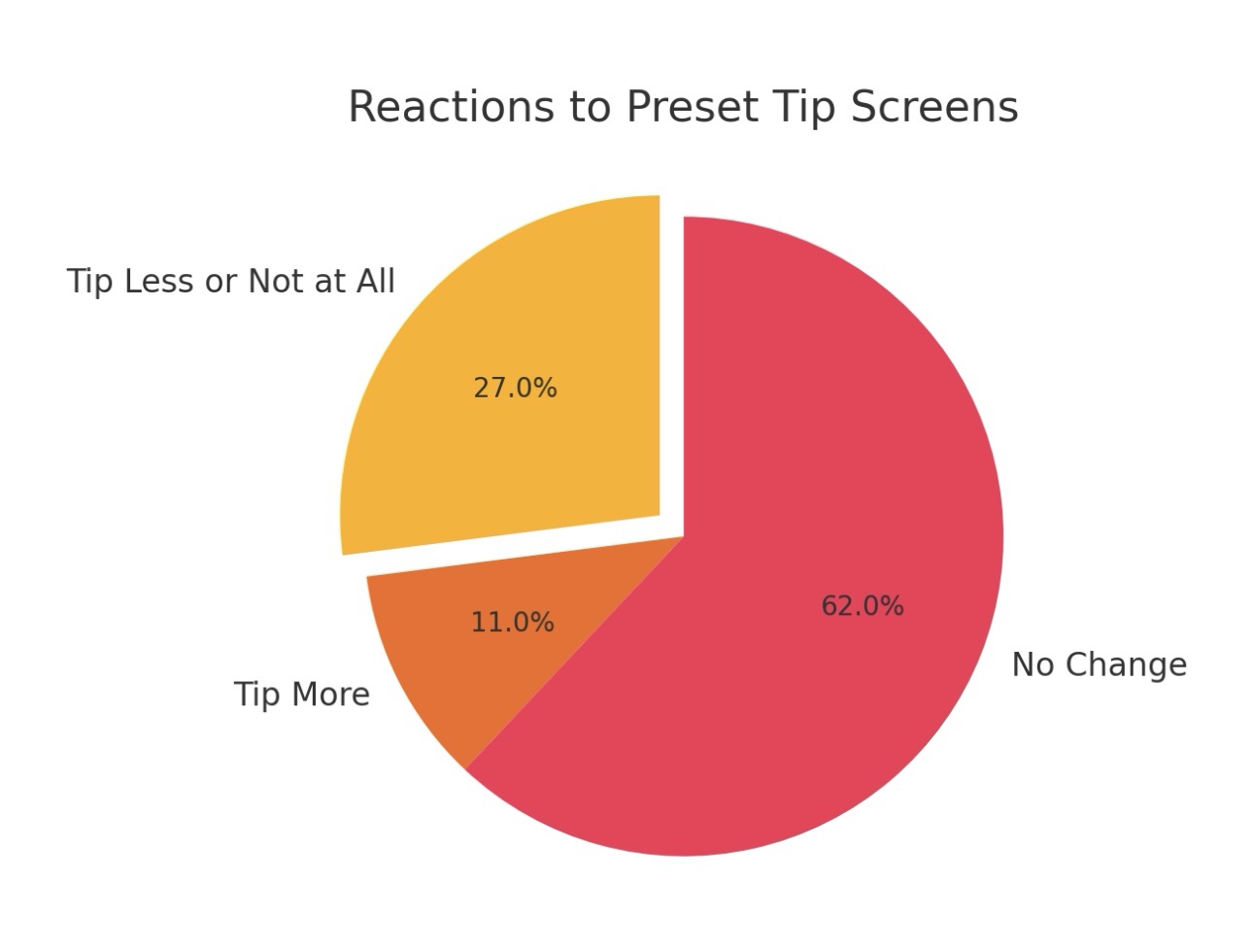
    Digital tip prompts may backfire.

    27% of Americans say they tip less or not at all when confronted with preset tip suggestions. Only 11% say they tip more because of them.

    Interestingly, older Americans are more irritated by tip screens:

    Gen X: 45% annoyed Boomers: 44% Millennials: 35% Gen Z: 27%

    Tip screens don’t make me more generous—they just make me mad.” – Survey respondent

    Expert Insight: Tipping fatigue is real, but don’t expect it to disappear,” says Ted Rossman, senior industry analyst at Bankrate. “The rise of apps and payment terminals has made tipping more visible—and more frequent—than ever.”

    Businesses are capitalizing on the moment. Rossman explains that tipping allows employers to increase pay without raising menu prices or wages directly, shifting the cost burden to the customer.

    Final Thoughts: Where Do We Go From Here?

    This survey captures a growing disconnect: Americans are frustrated by tipping, but the systems encouraging it are more entrenched than ever. The tipping backlash—especially among younger generations—could spark real changes in how workers are paid and how customers interact with service businesses.

    Source:

    Bankrate Tipping Survey 2025 – Press Release (PDF)

  • Americans Say Tipping Has Gone Haywire—Here’s What the Data Shows

    A new Forbes article by Gary Stoller lays bare what many Americans have been feeling for years: tipping culture is out of control.

    Based on a recent nationwide survey, nearly 90% of Americans believe tipping expectations have spiraled beyond reason. The study highlights growing frustration with how tipping has crept into nearly every transaction—often with little transparency and a lot of pressure.

    At endtippingculture.org, we believe tipping should never be a substitute for a fair wage. This new data shows just how broken the system has become.

    Key Findings from the Survey

    According to the study, Americans are voicing concerns about:

    Inconsistent Expectations: People are unsure when, how much, and who to tip. Rules vary wildly by industry, region, and even payment platform. Tipping Pressure: Digital screens now prompt users to tip for self-service, takeout, and even retail purchases—often with preset suggestions of 20% or more. Tipflation: Suggested tip amounts have risen dramatically in recent years, outpacing both wage growth and inflation.

    In short, tipping is no longer about service—it’s become a confusing, guilt-based transaction that benefits employers more than workers.

    What the 90% Are Really Saying

    That nearly 9 in 10 Americans feel tipping has “gone haywire” reveals a deeper truth:

    Most people don’t want to be responsible for subsidizing wages anymore.

    They’re tired of:

    Getting pop-up screens after minimal service Feeling judged for skipping a tip Having no idea where their money goes or how much workers actually keep

    It’s not about being cheap—it’s about a system that lacks clarity, consistency, and fairness.

    The State of Tipping in 2025

    Here’s a snapshot of what Americans are saying:

    “The State of Tipping in America”

    90% say tipping has gone too far 45% feel pressured by digital prompts 37% say they’re unsure when tipping is expected Most blame businesses—not workers—for the confusion

    What’s the Alternative?

    It’s time to end tipping culture—and this survey shows Americans are ready. Here’s how we can move forward:

    Demand fair wages for all workers, not “maybe” money based on customer mood Support no-tipping businesses that build gratuity into pricing Educate others about where tips go and why the current system is unsustainable

    Tipping was never meant to replace paychecks. It’s time we stop using it that way.

    Join the Movement

    If you’re tired of guessing tip amounts, dodging digital prompts, or feeling like a villain for not paying a worker’s wages:

    📢 You’re not alone—and you’re not wrong.

    Let’s build a system where service workers earn a guaranteed, fair living—without relying on unpredictable generosity.

    👉 Learn more and get involved at endtippingculture.org