Category: Tipping in US

Tipping in the US

  • State by State: How Tipped Wage Laws Differ Across the U.S.

    Tipping culture in the United States is deeply intertwined with labor law—and nowhere is that more visible than in the laws that govern the wages of tipped employees. While many consumers assume that servers and other tipped workers make the same minimum wage as every other worker, the reality is far more complex: states vary widely in whether they allow a tip credit, how large that credit can be, whether the tipped wage equals the full minimum wage, and how the wage laws are enforced.

    In this article, we’ll walk through the major dimensions of variation, highlight some key state-by-state examples, and explore why these differences matter for workers, businesses, and consumers.

    Key Concepts & Legal Framework

    Before diving into state comparisons, it’s helpful to define a few terms and frame the federal baseline.

    Tipped Employee: Under the Fair Labor Standards Act (FLSA), a tipped employee is one who “customarily and regularly receives more than $30 per month in tips”.  Tip Credit: A tip credit is the amount an employer may legally count toward the minimum wage by virtue of the tips the employee receives. For example, at the federal level, the cash wage could be as low as $2.13/hour and the maximum tip credit is $5.12/hour—which combined equal the federal minimum wage of $7.25/hour.  State Minimum Wage & Cash Wage Requirements: States can set their own higher minimum wages, higher tipped minimums, or even ban tipped wage differentials entirely. The federal standard sets a floor, but states may provide stronger protections. For example, some states require that tipped workers be paid the full state minimum wage before tips (effectively no tip credit allowed).  “No Tip Credit” States: Some states forbid employers from using any tip credit—so tipped workers must receive the full minimum wage in cash before tips. These states essentially remove the differential between tipped and non-tipped wages. For example: California, Washington, Oregon. 

    Understanding these dimensions sets the stage for seeing how state laws diverge.

    Patterns of Variation Across States

    Here are some of the major patterns you’ll find when comparing state tipped wage laws:

    States that pay tipped workers the full minimum wage (no tip credit allowed) These states treat tipped and non-tipped workers equally in terms of minimum hourly wage. Example: In California, tipped employees must still receive the full state minimum wage before counting tips.  The effect: Workers have a base wage guarantee, reducing dependence solely on tips and lowering risk of failing to make the minimum if tips are low. States that allow a tip credit, but with a high tipped wage (cash wage + tips) or higher base cash wage than federal minimum These states allow tipped employees to be paid less than the standard minimum wage in cash, but the total (wage + tips) must hit the state minimum or some set threshold. Example: Arizona allows a cash wage of $11.35 (as of one data set) plus a tip credit up to $3.00 to reach a total minimum of $14.35.  These laws still leave workers partly dependent on tips, but offer stronger protections than the federal minimum. States that apply the federal baseline (or near-baseline) with minimal state enhancements Some states simply default to the federal tipped wage rules or make only modest improvements. Example: Many states list the cash wage as $2.13/hour (federal level) and allow the full federal tip credit.  In such states, tipped workers may face higher income volatility, and their base wage is very low unless supplemented heavily by tips. Ongoing reforms / phase-outs Several states are in transition—proposals, ballot measures, or legislative action to phase out tip credits and move toward equal base wage for tipped workers. Example: In Massachusetts and Arizona, voters were set to decide on measures related to tipped worker sub-minimum wages.  This indicates momentum in some states toward stronger worker protections in the tipped wage sector.

    Select State Examples

    Below are snapshots of how different states approach tipped wage laws—illustrating the diversity.

    California (CA): Tipped employees must receive full state minimum wage before tips; effectively no tip credit allowed.  Washington (WA): Similarly strong protections; tipped workers receive the full minimum wage regardless of tips.  Arizona (AZ): Cash wage of about $11.35 + tip credit of $3.00 = total minimum wage of ~$14.35.  Florida (FL): At one point cash wage around $8.98 + tip credit $3.02 = ~ $12.00 minimum combined for tipped employees.  Missouri (MO): Cash wage of ~$6.15 + tip credit up to 50% of the applicable minimum wage (around $6.15) in one data table.  New York (NY): Tipped worker minimum wages vary by region and type of employer; the structure is more complex. 

    Why These Differences Matter

    These variations have important implications for several stakeholders:

    For workers: A higher base wage or prohibition of tip credit generally means more stable earnings and less dependence on luxury levels of tips or customer generosity. In low tipped wage states, workers may face more income volatility, and on slow shifts or in less tip-rich venues they may struggle to reach minimum wage. For business owners: States without tip credits may have higher payroll costs, which can affect pricing, staffing decisions, or service models. States with tip credits can maintain traditional tipping models but may face criticism around worker fairness and unpredictability of tipped income. For consumers and culture: In states where tipped workers are guaranteed a full wage, tipping becomes more of a genuine “bonus” rather than a substitute for fair pay. In states with minimal protections, consumers may bear more of the wage burden via tipping, often without full transparency. For policy & advocacy: The variation shows a patchwork of protections—with some states moving toward elimination of tipped sub-minimums. It also highlights the intersection of labor law, minimum wage policy, and the evolving service economy (gig work, delivery, etc.).

    Key Takeaways & Trends to Watch

    A growing number of states (and worker-advocacy groups) are pushing toward eliminating tip-subminimum wages (i.e., ensuring tipped workers get full minimum wage regardless of tips). The federal minimum wage for tipped employees remains fixed at $2.13/hour with a tip credit of $5.12/hour in many states—but these standards are increasingly seen as the floor only, not the norm.  Businesses and policymakers will need to adapt to changing service models (online ordering, delivery, self-service) which may shift tipping norms and thus wage models. For your audience (workers, business owners, consumers) it’s crucial to monitor both state laws and local ordinances (cities may have additional protections) because the nominal “tip rules” may differ by region, employer size, or venue.

    Conclusion

    Tipped wage laws across the U.S. vary dramatically—from states that require tipped workers to receive the full minimum wage regardless of tips, to states where the cash wage remains extremely low and tips are required to bring the worker up to the standard. For workers in the service industry, business owners navigating wage law, and consumers wanting fairness and transparency, understanding these differences matters. As the service economy evolves, so too will the laws and norms around tipping—and tracking those changes is essential to building solid content and advocacy.

  • “Tip Creep” Is Out of Control — And It’s Driving Customers Away

    Remember when tipping was reserved for servers at restaurants or your hairstylist? These days, it feels like no transaction is safe from the glowing digital screen asking for 15%, 20%, or even 25%. Whether you’re grabbing a muffin, buying a T-shirt, or simply swiping your card at a self-checkout kiosk, that tipping prompt is right there — and it’s wearing thin on consumers.

    Welcome to the era of tip creep, where tipping has expanded far beyond traditional service jobs and into nearly every corner of the retail experience. And Americans are getting fed up.

    What Is “Tip Creep”?

    Tip creep refers to the growing number of businesses and situations where customers are prompted (or expected) to leave a tip — even when no real service is involved.

    That includes:

    Self-serve frozen yogurt shops Retail counters Online orders with no human interaction Coffee stands where you pour your own drink

    This isn’t just awkward. It’s part of a bigger cultural shift — and one that’s backfiring for businesses.

    Consumers Are Starting to Push Back

    A 2024 survey by Pew Research found that:

    72% of Americans believe they’re being asked to tip in more places than ever before. 3 in 10 say they’ve actively avoided businesses that ask for tips too aggressively. 16% say they’re tipping less as a direct response to being constantly prompted.

    Even loyal customers are changing their behavior. It’s not about being cheap — it’s about feeling manipulated. When a screen flashes suggested tips before you’ve even had a chance to rate the service (or confirm there was any service), people understandably feel annoyed.

    Why Is This Happening?

    Much of it comes down to digital payment systems, which make it easier than ever for businesses to add a tipping option — even when it doesn’t make sense.

    Here’s why this matters:

    Tipping has become a substitute for fair wages. Many businesses, particularly small ones, are under pressure and use tips to supplement low hourly rates. Workers feel the heat, too. Employees may feel uncomfortable relying on tips in non-tipping situations, especially if their employer treats tips as part of expected income. Customers feel cornered. When the barista is staring at you or a line is waiting, people feel socially pressured to tip — not out of gratitude, but out of guilt.

    The Long-Term Impact

    Tipping used to be a reward for good service. Now it feels more like a fee to complete a basic transaction. This shift erodes the value of tipping altogether.

    When customers are asked to tip in every scenario, several things happen:

    Tipping loses its meaning. Service quality no longer matters as much. Trust in the business drops. Customers leave or reduce spending.

    And for businesses, the biggest risk is that they’re losing repeat customers — not because of poor products or unfriendly staff, but because the checkout experience feels predatory.

    What Can Be Done?

    Tipping culture won’t change overnight — but you can be part of the shift. Here’s how:

    As a customer:

    Tip where it’s deserved, not where it’s demanded. Don’t feel guilty for skipping tips on non-service transactions. Support businesses that pay workers fairly without relying on tips.

    As a business:

    Be transparent about pricing and pay structure. Pay employees fair wages, especially in roles that traditionally didn’t include tipping. Use optional, not default, tipping prompts — and consider whether a tip prompt is appropriate at all.

    Final Thoughts

    Tip creep isn’t just annoying — it’s unsustainable. We’re long overdue for a cultural reset on when, where, and why we tip. Businesses should focus on paying workers fairly. Customers should feel empowered to tip when it’s earned — not when it’s awkwardly demanded.

    At EndTippingCulture.org, we believe a fair, transparent system works better for everyone — and that gratitude should never be a transaction forced at checkout.

  • Should You Tip in Cash?

    Here’s Why It Still Matters

    In a world increasingly dominated by digital payments, mobile apps, and tap-to-pay convenience, one old-school habit still lingers: tipping in cash. But is it still necessary? And does it actually make a difference?

    The short answer: yes—especially for service workers. Here’s why.

    Cash Tips Go Directly to the Worker

    When you tip in cash, the money goes straight to your server, bartender, or delivery driver—no waiting, no processing delays, and no possibility of the business skimming a cut. It’s immediate, tangible appreciation.

    By contrast, credit card tips often:

    Take days to show up in paychecks May be taxed differently Can be partially withheld or pooled at management’s discretion

    It Helps Offset Low Wages

    Many tipped workers earn a sub-minimum wage (as low as $2.13/hour in some U.S. states), making tips a crucial part of their income. Cash tips help workers take home more money right away—especially in jobs where shifts fluctuate or hours are unpredictable.

    Not All Workers See Their Digital Tips

    Digital tip jars are growing in popularity, but they often lack transparency. When you tip on a tablet or app:

    You don’t always know who gets it The business might divide it among all staff—or keep a portion Some tip-sharing policies are not disclosed

    Cash removes the guesswork.

    It Can Boost Morale and Motivation

    There’s something encouraging about receiving cash in hand after a long shift. It can be a real morale booster and a sign of direct appreciation—especially in fast-paced, customer-facing environments.

    It’s Still the Best Option for Certain Jobs

    Consider tipping in cash if you’re dealing with:

    Hotel housekeeping Valets Barbers and stylists Massage therapists Movers Taxi drivers These workers often don’t have an easy way to process tips digitally, and cash is still the most reliable method.

    But What If You Don’t Carry Cash?

    Many people don’t carry cash anymore. That’s understandable—but if you plan to tip:

    Try to keep small bills on hand for service situations Use apps like Venmo or Cash App if the worker requests it Ask the business if cash tipping is preferred

    Final Thought: A Small Act With a Big Impact

    Tipping in cash might seem old-fashioned, but it’s one of the most effective ways to support workers in a broken wage system. Until fair wages are the norm, consider carrying a few bills in your wallet—it could make someone’s day.

  • Tariffs, Inflation, and the Strain on Tipping Culture

    How Inflation and Tariffs Are Changing the Way We Tip

    With inflation still lingering and new tariffs hitting imported goods, Americans are feeling the pinch in their everyday spending—from groceries and utilities to restaurants and ride shares. But while base prices are going up, tipping culture hasn’t slowed down. In fact, in many places, it’s accelerating. This double burden—higher prices plus higher tipping expectations—is pushing many consumers to a breaking point.

    What’s Happening to Prices?

    Inflation continues to drive up costs for food, labor, energy, and essentials. Tariffs on imported goods—from steel to food to electronics—are passed down to consumers in the form of higher prices. Service industries, such as restaurants and salons, are raising prices to cover their increased costs.

    That means your $18 lunch is now $21—and with tip prompts still suggesting 20–25%, you’re suddenly paying $26 for a sandwich and soda.

    The Result? Tip Fatigue Meets Sticker Shock

    Consumers are being asked to tip:

    More frequently (coffee shops, takeout, self-service kiosks) On higher base prices (due to inflation/tariffs) For lower perceived service (such as counter pickup)

    This creates a tipping environment that feels less like generosity and more like a hidden tax.

    Impact on Workers

    Tipped workers are also struggling. While prices rise, tips aren’t always keeping pace. If consumers scale back due to economic stress, service workers may end up earning less despite businesses charging more.

    Are Businesses Shifting the Burden?

    Some companies avoid raising wages by outsourcing compensation to customers through tipping prompts—even during times of economic hardship. This approach:

    Reduces employer costs Avoids accountability for wage increases Frustrates both customers and employees

    What Needs to Change?

    ETransparent pricing: List real wages and real costs instead of relying on tipping pressure. Fair wages for workers: Employers should raise base pay rather than expecting customers to shoulder inflation-driven compensation. Reevaluate tipping culture: In an economy where everything is more expensive, forcing a cultural norm that adds another 20% is unsustainable.

    Bottom Line

    As inflation and tariffs increase the cost of living, tipping culture is showing its cracks. What started as a reward for exceptional service has turned into a reflexive obligation layered onto already inflated costs. Both consumers and workers deserve a better, more equitable solution—one that doesn’t rely on emotional manipulation or endless tip prompts.

    Related Articles:

    The Hidden Cost of Tipping

    Tip Creep Is Out of Control

    Are No-Tipping Restaurants the Future?

  • Americans Are Tired of Tipping

    Americans Are Tired of Tipping

    The survey found a wide range of frustrations:

    41% say tipping culture is out of control. 41% believe businesses should pay employees better instead of relying on customer tips. 38% are annoyed by digital payment screens that prompt for a tip—often before service has even been rendered.

    Younger Generations Tip Less—and Less Often

    Generational differences in tipping behavior are significant. The survey shows that Gen Z and millennials are much less likely to tip consistently across industries.

    Who always tips their hair stylist/barber?

    Gen Z: 25% Millennials: 45% Gen X: 67% Boomers: 71%

    Who always tips at sit-down restaurants?

    Gen Z: 43% Millennials: 61% Gen X: 83% Boomers: 84%

    Even the size of the tip varies:

    Only 16% of Gen Z and 30% of millennials usually tip 20% or more at restaurants. That compares to 40% of Gen X and 49% of baby boomers.

    Tip Screens May Be Hurting, Not Helping

    Digital tip prompts may backfire.

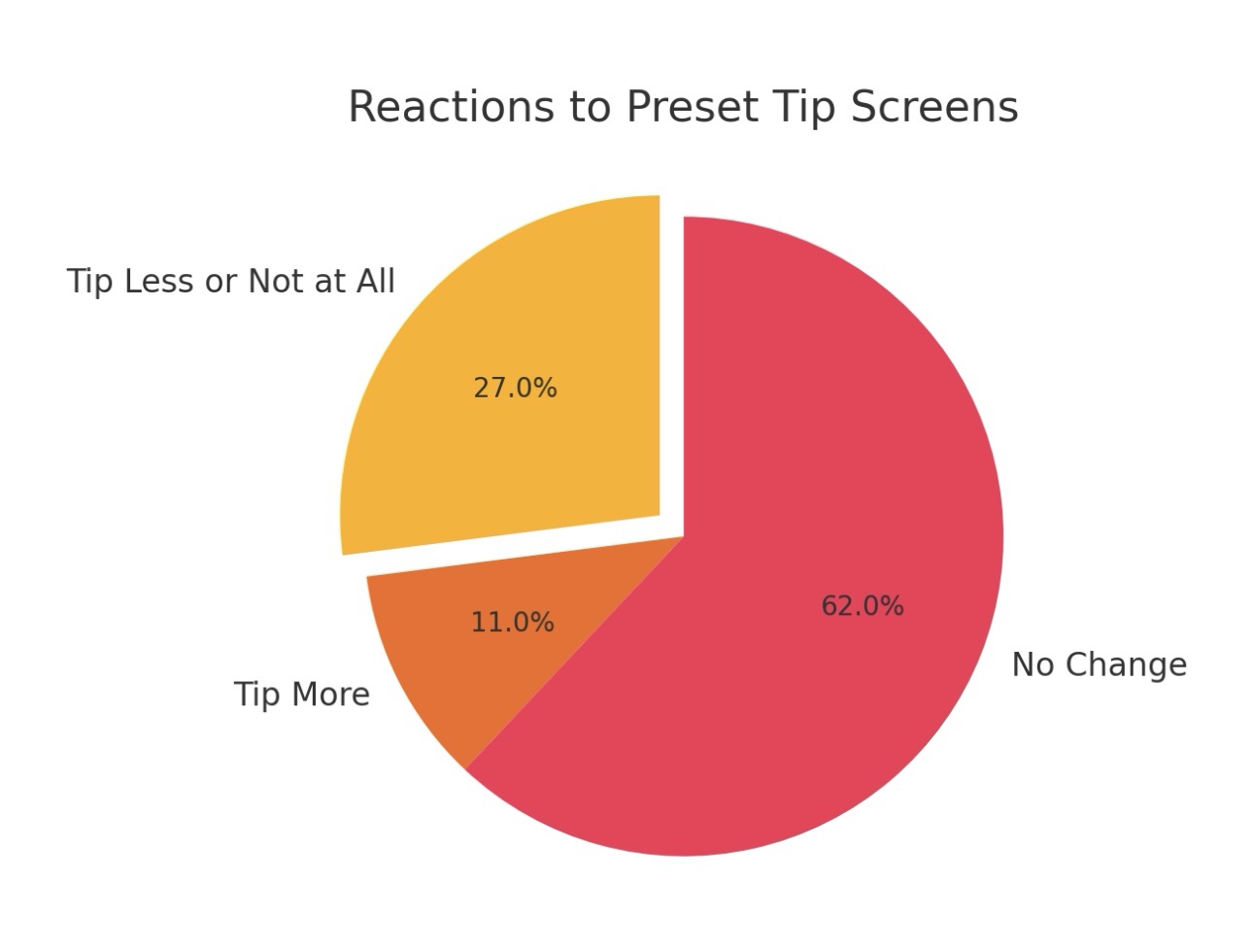
    27% of Americans say they tip less or not at all when confronted with preset tip suggestions. Only 11% say they tip more because of them.

    Interestingly, older Americans are more irritated by tip screens:

    Gen X: 45% annoyed Boomers: 44% Millennials: 35% Gen Z: 27%

    Tip screens don’t make me more generous—they just make me mad.” – Survey respondent

    Expert Insight: Tipping fatigue is real, but don’t expect it to disappear,” says Ted Rossman, senior industry analyst at Bankrate. “The rise of apps and payment terminals has made tipping more visible—and more frequent—than ever.”

    Businesses are capitalizing on the moment. Rossman explains that tipping allows employers to increase pay without raising menu prices or wages directly, shifting the cost burden to the customer.

    Final Thoughts: Where Do We Go From Here?

    This survey captures a growing disconnect: Americans are frustrated by tipping, but the systems encouraging it are more entrenched than ever. The tipping backlash—especially among younger generations—could spark real changes in how workers are paid and how customers interact with service businesses.

    Source:

    Bankrate Tipping Survey 2025 – Press Release (PDF)

  • Who Tips the Most (and Least) in the U.S.?

    State-by-State Survey Reveals the Divide

    A recent survey from USA Today Blueprint, conducted by OnePoll, reveals major differences in how Americans tip — depending on where they live, how much they earn, and even how old they are. With 5,000 people surveyed (100 per state), the findings are both eye-opening and a reminder of just how inconsistent and unsustainable tipping culture has become.

    Key Findings

    National average tip: 17.94% Top tipping state: California (22.69%) Lowest tipping state: Illinois (14.22%) Best tippers by age: Millennials, averaging 18.18% Income matters: The more you make, the more you tip

    Tipping by State: Coastlines Lead, Midwest Lags

    According to the data, coastal states tend to tip more generously than those in the middle of the country — with one big exception: Missouri, which comes in second nationwide.

    Top 10 Best-Tipping States

    These states average 20.54% across restaurant meals, delivery, personal care, and service-based interactions.

    A $75 meal in California would average a $17.01 tip, bringing the total to $92.01 (before tax).

    Bottom 10 Worst-Tipping States

    A $75 bill in Illinois? That’s just a $10.66 tip — totaling $85.66 before tax.

    Notably, four of the bottom 10 states still follow the federal tipped minimum wage of just $2.13 per hour, including Mississippi, Tennessee, South Carolina, and Utah.

    Tipping Fatigue Is Growing

    Americans are tipping more often — and in more places — but not always because they want to.

    Survey respondents said the top reasons they tip are:

    Feeling the worker earned it Feeling expected to tip in certain industries

    Feeling guilty if they didn’t

    Other reasons included:

    Wanting to support low-wage workers

    Being familiar with how hard the job is

    Showing appreciation for good service

    What This Means for EndTippingCulture.org

    This survey underscores what we already know: Tipping is not a fair or consistent way to compensate workers.

    The difference between a 14% and 22% tip isn’t just about kindness — it’s about who’s responsible for paying wages. Tipped workers shouldn’t depend on geography or guilt to earn a livable income. We believe it’s time to move toward no-tip models, where businesses pay fair wages directly, and customers aren’t pressured at every turn.

    Source: USA Today Blueprint

    Survey conducted by OnePoll from Sept. 11–25, 2023 with 5,000 respondents (100 per state). Margin of error: ±1.4%.

  • Tipping at a Low-Cost Diner

    Small Bill, Big Dilemma

    A hot coffee, a $9 breakfast, and a friendly “hon”—that’s the charm of a classic American diner. But when your total comes to $11.42, you might find yourself hesitating over the tip. Is $2 enough? Is 15% insulting? Should you be tipping more, even if the meal cost less than a cocktail downtown?

    Inexpensive diners pose one of the biggest contradictions in tipping culture: Service is the same, but the tip is smaller simply because the food is cheaper. Here’s how to navigate that and why it matters.

    The Value of the Service Doesn’t Change

    Whether your server delivers a $6 burger or a $60 steak, they still:

    Greet you with a smile Take your order Refill your drinks Bus your table Handle your check

    The labor is the same, even if your tab is not. Tipping only a percentage can unintentionally penalize servers at affordable establishments.

    20% of $10 Is Just $2—That’s Not Much

    Yes, $2 is technically a 20% tip on a $10 check—but that may barely cover your server’s sidework for that table. Servers in diners often rely on high table turnover and multiple tips just to hit minimum wage levels.

    Consider this: if you tip $2 per table and they serve six tables an hour, that’s only $12/hour—before taxes.

    Tip Minimums Are a Helpful Rule of Thumb

    If you’re at a low-cost diner, consider setting a minimum tip—such as $3–$5, even if the bill is low. Think of it like a cover charge for quality service.

    A few guidelines:

    For bills under $10, leave at least $2–$3 For $10–$20 bills, aim for $3–$5 Above $20, tip 18–20% as usual

    Diners Are Often Where Workers Struggle Most

    Diner servers often work long shifts, handle large sections, and rarely earn high tips compared to those in fine dining. Many:

    Earn below the standard minimum wage Work without benefits May not receive pooled tips or shared gratuity

    A few extra dollars from you can make a huge difference in their take-home pay.

    Tipping Fairly Supports Dignity in All Service Work

    Tipping more generously at affordable restaurants isn’t about generosity—it’s about equity. You’re helping ensure that workers providing the same level of effort as those in higher-end venues aren’t shortchanged because you ordered pancakes instead of filet mignon.

    Final Thought: A Small Tip Can Still Be a Big Gesture

    That $3 tip on a $10 meal may seem small, but it sends a powerful message: you see the person, not just the price. Until tipping culture changes or is replaced by fair wages, this is one way we can close the gap and show respect to the people behind our favorite neighborhood joints.

  • The Hidden Cost of Tipping

    Who Really Pays?

    At first glance, tipping seems simple: you reward good service with a few extra dollars. But behind that small gesture is a system that quietly shifts the responsibility of paying workers away from businesses—and onto you, the customer.

    Tipping in America isn’t just a custom. It’s a loophole that keeps wages low, business expenses down, and workers vulnerable.

    So the real question is: Who’s actually paying the cost of service?

    The Illusion of Generosity

    When you tip, you probably feel like you’re helping the server. And you are. But you’re also subsidizing the employer.

    Here’s how:

    In most U.S. states, employers can legally pay tipped workers as little as $2.13/hour. Employers are supposed to make up the difference if tips don’t reach minimum wage—but enforcement is weak. The result? Customers, not businesses, provide the majority of a worker’s income.

    It’s not a thank-you gift. It’s a structural crutch.

    What Businesses Gain from Tipping

    Restaurants, salons, delivery platforms, and service industries benefit greatly from the tipping model. Here’s why:

    Lower labor costs: Businesses save on payroll by paying subminimum wages. No need to raise prices: Tipping keeps menu prices deceptively low, while customers make up the difference. Flexible income model: Employers avoid long-term financial commitment to their workers by letting income fluctuate daily.

    In short: tipping shifts the risk from employers to workers and customers.

    What Workers Lose

    Tipped workers face more than just unstable pay. The entire system places them in a vulnerable position:

    Income volatility: A slow day or rude customer can destroy a paycheck. Discrimination and harassment: Workers feel pressure to tolerate inappropriate behavior to protect their income. Wage theft: Many are unaware when they’re underpaid or shorted on owed wages.

    Even worse, tips are often pooled or partially retained by owners, further blurring where your money goes.

    What Customers Are Really Paying For

    When you pay a tip:

    You’re covering wages that employers should be paying. You’re funding an unregulated, inconsistent income stream for workers. You’re absorbing business expenses—without transparency.

    Think of tipping as a service tax—one that’s optional in theory, but mandatory in practice. And unlike actual taxes, it doesn’t go toward public goods—it just helps keep businesses profitable.

    Tipping vs. Transparent Pricing

    Let’s say you pay $20 for a meal and tip 20%. You’re really spending $24—but the business only listed the price as $20.

    Now imagine if prices simply reflected the true cost of labor. That $24 would be built in, workers would get a stable wage, and customers would know exactly what they’re paying for—up front and guilt-free.

    This is how it works in many other countries. And it can work here too.

    The Real Cost Is Hidden—But We All Pay

    Whether you’re a customer frustrated by tipping fatigue, or a worker scraping by on unpredictable earnings, the system fails everyone except business owners who profit from it.

    It’s not tipping that’s the problem—it’s the dependence on tipping.

    There’s a Better Way

    At EndTippingCulture.org, we believe:

    • Employers—not customers—should pay workers Wages should be fair, stable, and built into pricing Workers shouldn’t be financially punished for slow nights, bad weather, or difficult guests
    • Let’s stop hiding the cost of labor. Let’s start demanding a system that values work fairly.

    Join the movement to End Tipping Culture.

  • Does Tipping a Percentage Make Sense?

    Why It’s Unfair to Lower-Cost Places

    In the U.S., tipping is almost always calculated as a percentage of your bill—usually 15% to 25%. But have you ever stopped to ask: Why?

    Why does a $100 dinner earn a $20 tip, while a $10 meal earns just $2—when the server might have done the exact same amount of work?

    The percentage-based tipping model is not only arbitrary—it’s unfair. And it reinforces a broken system that penalizes workers at affordable establishments while over-rewarding those at high-end venues.

    Same Work, Different Tip

    Consider this:

    A server at a diner refills coffee, delivers hot food, and checks in multiple times. Your bill is $15, and you tip $3 (20%). A server at a high-end restaurant brings a $150 bottle of wine and a $100 steak. Your bill is $300, and you tip $60 (20%).

    Did the second server work 20 times harder than the first? Probably not. In fact, the work may be easier—fewer tables, more support staff, and customers who linger longer.

    Percentage tipping rewards price, not performance.

    Low-Cost Doesn’t Mean Low-Effort

    Workers at casual restaurants, cafes, food trucks, and diners often:

    Turn tables faster Serve more customers Have fewer support staff (they’re the host, busser, and server) Work for lower hourly wages

    Yet they consistently receive smaller tips, simply because the food is cheaper—even though their labor is just as valuable.

    High-End Restaurants: A Tipping Illusion

    In upscale dining, prices are often inflated due to branding, ambiance, or ingredient sourcing—not because the service is dramatically better.

    Still, servers at these places:

    Earn disproportionately more in tips Often get better schedules and higher hourly rates Are tipped for prestige, not for harder or faster work

    This deepens the inequality between workers in fine dining and those in everyday service jobs—even though both rely on tips to survive.

    Customers Feel the Pressure, Too

    The percentage model also punishes the customer:

    You’re expected to tip more simply because you ordered something expensive, even if the service was the same. You may feel guilted into tipping more at upscale places to avoid looking “cheap,” even when the experience doesn’t warrant it.

    A Fairer Way Forward

    At EndTippingCulture.org, we advocate for moving away from the percentage-based tipping model entirely. Why?

    Because fair wages:

    Level the playing field for all workers—regardless of where they work Remove price-based bias from service pay Let customers know the true cost upfront without a hidden “service tax”

    Some restaurants are already adopting service charges or living wage pricing, eliminating the need to tip at all. It’s a system that pays people for their labor—not for the value of your dinner.

    Final Thought: Is It About Service—Or Spending?

    If tipping is supposed to be about rewarding good service, why is it tied to how much you spend?

    Shouldn’t someone working hard at a lunch counter be compensated just as fairly as someone working at a luxury steakhouse?

    It’s time to tip the conversation in a new direction.

    Join the movement to End Tipping Culture

  • Tipping in America: A 50-Year Evolution

    Over the past half-century, tipping in the United States has transformed from a modest gesture of appreciation to a widespread expectation, permeating various service industries. This evolution reflects broader societal shifts, economic policies, and technological advancements.

    📜 Timeline: Key Milestones in U.S. Tipping Culture

    1970s: Standardization of Tipping Percentages

    Tipping norms solidify, with 10% becoming the standard gratuity in restaurants.

    1980s: Increase in Tipping Expectations

    The standard tip rises to 15%, reflecting inflation and changing service industry dynamics.

    1990s: Expansion Beyond Dining

    Tipping becomes customary in additional sectors, including salons, taxis, and hotel services.

    2000s: Digital Payment Systems Introduce New Norms

    The advent of digital payment platforms introduces preset tipping options, influencing customer behavior.

    2010s: Rise of ‘Tipflation’

    Tipping expectations escalate, with 20% becoming the new norm in many establishments.

    2020s: Tipping Culture Under Scrutiny

    Public discourse intensifies around tipping practices, with debates on fairness and the role of employers in ensuring fair wages.

    📊 Current Trends and Public Sentiment

    Recent surveys indicate a growing discomfort with tipping culture:

    A Pew Research Center study found that 72% of Americans feel they’re being asked to tip in more places than five years ago.  Bankrate reports that two-thirds of U.S. adults have a negative view of tipping, with 30% believing it’s “out of control.” 

    These sentiments reflect a broader concern about the sustainability and fairness of the current tipping system.

    🔮 Looking Ahead

    The future of tipping in the U.S. remains uncertain. While some advocate for the elimination of tipping in favor of fair wages, others believe in preserving the tradition with reforms to address its shortcomings. As the conversation continues, it’s clear that tipping culture is at a crossroads, prompting both consumers and industry stakeholders to reconsider its role in modern society.