Tag: tipping survey

  • Dining & Tipping in the Post‑COVID Era: What’s Changed — and What Stays the Same

    Dining & Tipping in the Post‑COVID Era: What’s Changed — and What Stays the Same

    When the pandemic hit, dining out went from social outing to logistical feat. As restaurants closed or shifted to takeout and delivery, tipping norms changed dramatically. Now, with dining rooms reopened and life settling into a new rhythm, we’re seeing long-lasting shifts in how people eat — and tip.

    A recent survey from CouponCabin offers a revealing look at these post-pandemic habits. You can view their original infographic here.

    Key Stats from the Survey

    • 1,007 U.S. adults were surveyed in August 2025 about their current dining and tipping habits.
    • 33% of Americans say they tip more now than they did before the pandemic.
    • 62% tip about the same, and only 5% say they tip less.
    • The most common tipping amount was 20%, with 34% of respondents selecting it.
    • 8% of people tip more than 20%, while 19% tip less than 10%.
    • 35% of people now dine out more than they did pre-pandemic.

    (Sources: CouponCabin, Newsweek)

    What This Means for Tipping Culture

    1. Tipping is rising — even with inflation

    Despite rising prices and economic uncertainty, many Americans have continued to tip generously. That pandemic-era empathy for service workers seems to have stuck — but is it sustainable?

    2. The 20% standard holds, but extremes are growing

    While 20% remains the tipping “anchor,” more people are moving above or below that range. This signals growing frustration on one end — and growing pressure on the other.

    3. Dining out feels more premium

    Dining out is no longer the default. Many people treat it as a special experience — and tip accordingly. But when expectations rise in casual or takeout settings, it raises questions about fairness.

    4. Tips are replacing wages

    As tipping becomes universal — even for counter service or takeout — it’s clear that businesses are still relying on customers to cover what should be base wages. The line between tip and wage has never been blurrier.

    What Can You Do as a Diner?

    Be intentional. Tip when it feels appropriate, not just because the screen prompts you to. Don’t be afraid to customize. You don’t have to accept a default of 25% for a muffin and coffee. Support businesses that pay fairly. The best way to end tipping culture is to reward places that bake fair wages into their pricing.

    Related Reading on EndTippingCulture.org

    Attachment.pngTipping on Rideshare and Delivery Apps Attachment.pngTipping at Dog Groomers: Private vs. PetSmart Attachment.pngExtreme Tip Prompts: What to Do When 100% Is an Option

    Final Takeaway

    The pandemic didn’t just change how we live — it changed how we tip. What started as a show of solidarity has evolved into a system that too often feels obligatory and unbalanced. As tipping culture continues to grow in scope and expectation, it’s time to have an honest conversation about where the responsibility lies — and whether this is the system we want to keep.

  • Americans Spent Nearly $78 Billion on Tips in 2023

    Americans Spent Nearly $78 Billion on Tips in 2023

    A Deep Dive into Tipping Trends

    A new LendingTree analysis of 2023 USDA data reveals that Americans dropped a whopping $77.6 billion on tips for food purchased away from home. That staggering number reflects tipping culture’s deep roots and growing pervasiveness. 

    Key Takeaways

    15.0% of spending at full-service restaurants went to tips, while the broader category of food away-from-home (including fast-food, bars, hotels, etc.) averaged 6.75%  .

    New Hampshire tops the chart: tipping 16.07% of away-from-home food spending—the highest in the nation. Utah lags at just 4.09%.

    Across the U.S., 55.7% of household food budgets now go to meals eaten out—an increase from 49.4% in 2000.

    The District of Columbia leads in per‑capita dining-out outlays, with residents spending an average of $10,291 annually, far ahead of the next highest state, Nevada, at $6,752.

    Illinois saw the greatest shift toward dining out since 2000—rising 13.5 percentage points in its away-from-home food share.

    Why It Matters to Tipping Culture

    Tipping Has Transcended Traditional Settings

    Once reserved for sit-down restaurants, tipping habits have expanded. Data even includes gratuities at quick-service venues and vending kiosks—underscoring how tipping is permeating every corner of the food economy.  Regional Norms Drive Wide Variation

    The tipping gap between states—from New Hampshire’s 16.1% to Utah’s 4.1%—highlights the influence of local customs, dining preferences, and regional living costs. 

    Dining Out Is Now the Norm

    With Americans allocating over half of their food budgets to eating out, tipping decisions now have broad economic impact, touching the lives of workers across countless food-service settings.  Economic & Cultural Pressures Fuel the Tipping Trend

    Though the study focused on totals, related LendingTree research and surveys show many consumers feel compelled to tip—even in fast food and takeout settings. This pressure is amplified by increased digital prompts and shifting norms.

    Implications for Workers and Diners

    For Workers: A $77.6 billion tipping pool is a major income stream—but its uneven distribution and dependency on consumer habits can leave workers vulnerable.

    For Diners: Tipping is no longer optional in many scenarios. Understanding where, when, and why to tip—and how much—has become a vital part of budgeting.

    For Policy & Industry: As tipping spills into fast-food and other unconventional sectors, there’s growing debate over minimum wages, tipping apps, and whether tipping norms need reevaluation.

    Final Thoughts

    The LendingTree study offers a comprehensive snapshot of tipping’s expanding role in the American dining landscape:

    New Hampshire’s 16% average sets a tipping high water mark. Over half of food spending is out-of-home, marking a cultural shift toward dining-centric habits. Combined with consumer pressure and tech-facilitated nudges, tipping is now an inescapable part of everyday transactions.

    For End Tipping Culture, this analysis raises important questions:

    Should tipping continue to spread beyond full-service dining? How do we balance fair compensation with the expectation it creates for guests? Is it time to reconsider tipping’s place in labor practices and consumer norms?

    LendingTree study

  • Americans Are Tired of Tipping

    Americans Are Tired of Tipping

    The survey found a wide range of frustrations:

    41% say tipping culture is out of control. 41% believe businesses should pay employees better instead of relying on customer tips. 38% are annoyed by digital payment screens that prompt for a tip—often before service has even been rendered.

    Younger Generations Tip Less—and Less Often

    Generational differences in tipping behavior are significant. The survey shows that Gen Z and millennials are much less likely to tip consistently across industries.

    Who always tips their hair stylist/barber?

    Gen Z: 25% Millennials: 45% Gen X: 67% Boomers: 71%

    Who always tips at sit-down restaurants?

    Gen Z: 43% Millennials: 61% Gen X: 83% Boomers: 84%

    Even the size of the tip varies:

    Only 16% of Gen Z and 30% of millennials usually tip 20% or more at restaurants. That compares to 40% of Gen X and 49% of baby boomers.

    Tip Screens May Be Hurting, Not Helping

    Digital tip prompts may backfire.

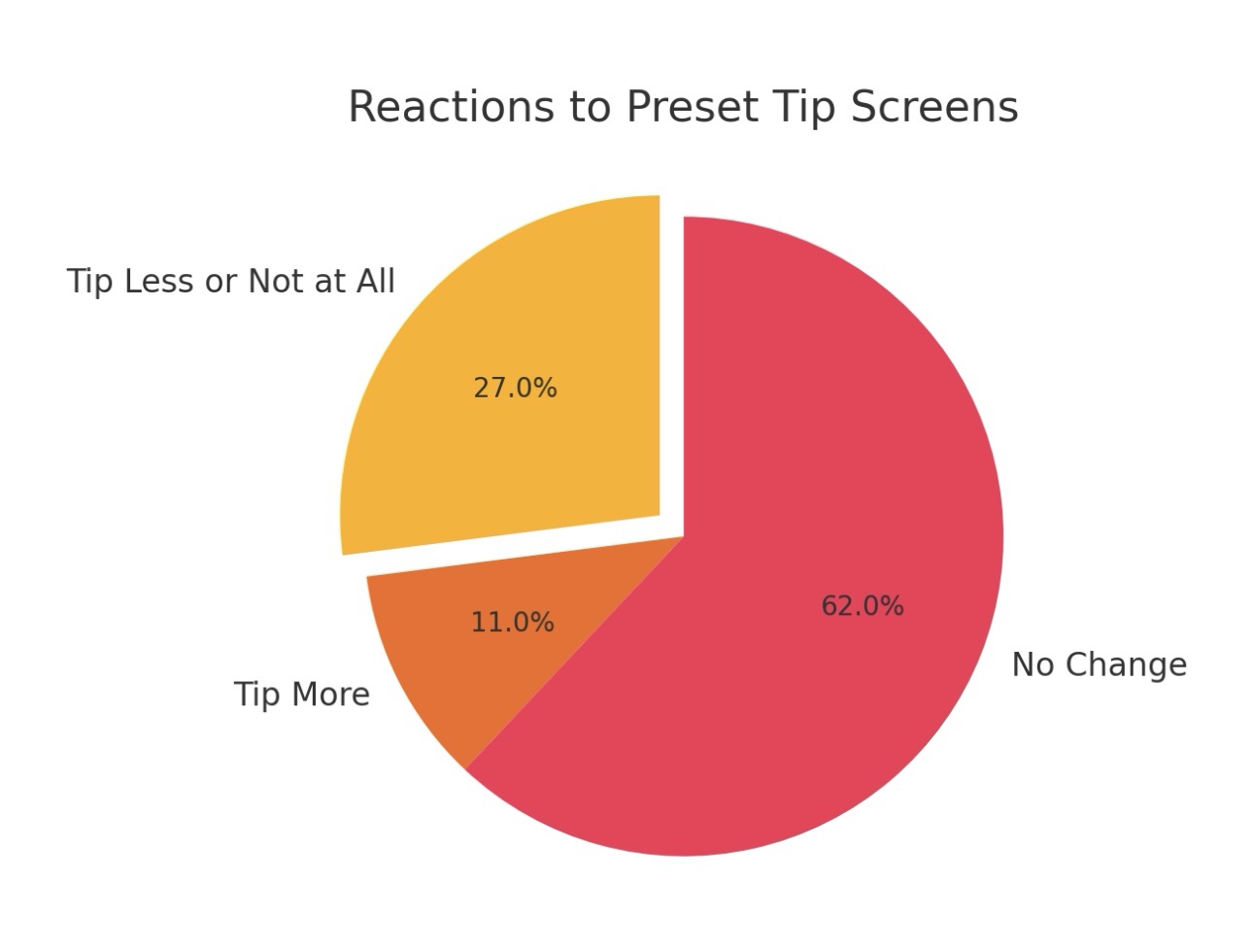
    27% of Americans say they tip less or not at all when confronted with preset tip suggestions. Only 11% say they tip more because of them.

    Interestingly, older Americans are more irritated by tip screens:

    Gen X: 45% annoyed Boomers: 44% Millennials: 35% Gen Z: 27%

    Tip screens don’t make me more generous—they just make me mad.” – Survey respondent

    Expert Insight: Tipping fatigue is real, but don’t expect it to disappear,” says Ted Rossman, senior industry analyst at Bankrate. “The rise of apps and payment terminals has made tipping more visible—and more frequent—than ever.”

    Businesses are capitalizing on the moment. Rossman explains that tipping allows employers to increase pay without raising menu prices or wages directly, shifting the cost burden to the customer.

    Final Thoughts: Where Do We Go From Here?

    This survey captures a growing disconnect: Americans are frustrated by tipping, but the systems encouraging it are more entrenched than ever. The tipping backlash—especially among younger generations—could spark real changes in how workers are paid and how customers interact with service businesses.

    Source:

    Bankrate Tipping Survey 2025 – Press Release (PDF)